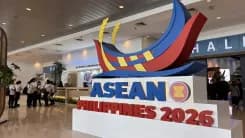
(NET25 NEWS) — As Southeast Asian leaders prepare to gather in Manila, two longstanding regional challenges are once again testing ASEAN's ability to turn diplomatic commitments into concrete progress: Myanmar's continuing political crisis and negotiations for a Code of Conduct in the South China Sea.
Philippine Foreign Affairs Secretary Maria Theresa Lazaro offered a measured assessment of both issues on Saturday, signaling that while diplomatic efforts are advancing, major decisions remain unresolved.
On Myanmar, Lazaro made clear that ASEAN has not reached any decision to ease restrictions on the country's representation at high-level meetings. The bloc's Five-Point Consensus, adopted in 2021 to address the crisis following the military takeover, remains on the table.
"There is no decision on that," Lazaro said, referring to the possibility of Myanmar's foreign minister taking a seat at ASEAN meetings.
She recalled that ASEAN foreign ministers had already discussed the issue with Myanmar's new foreign minister during a meeting in Bangkok last July. However, the discussions have yet to produce a change in the bloc's position.
Her remarks underscore the difficult balance ASEAN continues to face: maintaining diplomatic engagement with Myanmar while pressing for progress on its commitments to restore peace and stability.
The Five-Point Consensus calls for an immediate cessation of violence, constructive dialogue among all parties, mediation facilitated by ASEAN, humanitarian assistance, and a visit by an ASEAN special envoy to meet all concerned parties.
More than five years after its adoption, however, the framework continues to face questions over its implementation and effectiveness. The absence of a breakthrough also highlights the limits of ASEAN's consensus-based approach, which requires member states to navigate differing political interests and positions.
For the Philippines, the challenge is to preserve ASEAN's credibility without allowing the Myanmar crisis to undermine the bloc's broader regional agenda.
SOUTH CHINA SEA CODE OF CONDUCT GAINS MOMENTUM
Another major issue expected to figure prominently at the Manila summit is the long-running effort to establish a Code of Conduct between ASEAN and China for the South China Sea.
Lazaro said negotiations have made substantial progress, with approximately 77 percent of discussions completed.
"I mean, the progress of the Code of Conduct is really hastened," she said, adding that there could be a definitive development and that a statement would be released during the summit.
Her assessment points to renewed momentum in negotiations that have dragged on for years, despite repeated commitments by ASEAN and China to finalize an agreement.
The Code of Conduct is intended to establish guidelines for managing tensions, preventing incidents, and promoting stability in the strategically important waterway. But the remaining negotiations are likely to involve some of the most difficult questions, including the scope, legal character, and implementation of the proposed agreement.
For the Philippines, the stakes are particularly high. As a claimant in the South China Sea disputes, Manila has consistently called for respect for international law, including the 1982 United Nations Convention on the Law of the Sea and the 2016 arbitral ruling on the South China Sea.
The reported 77-percent progress is therefore significant, but it should not be mistaken for a completed agreement. The remaining 23 percent could determine whether the Code of Conduct becomes a meaningful framework for managing disputes or remains another diplomatic commitment without sufficient enforcement mechanisms.
Lazaro also emphasized that developments during the Philippines' ASEAN chairship have been acknowledged by both ASEAN members and China, although she said further discussions were still underway.
A TEST OF ASEAN'S COLLECTIVE RESPONSE
The two issues illustrate the broader challenge confronting ASEAN as it meets in Manila.
Beyond Myanmar and the South China Sea, regional foreign ministers are also facing mounting energy costs, security concerns, and the approaching threat of El Niño. These interconnected challenges demand cooperation at a time when geopolitical rivalries and differing national priorities continue to test regional unity.
For Philippine President Ferdinand Marcos Jr., the summit presents an opportunity to demonstrate that ASEAN can remain relevant and responsive to the concerns of its member states, even as the region faces increasingly complex security and economic pressures.
But the measure of the Manila summit will not simply be the number of statements issued or the progress percentages announced. It will be whether member states can translate diplomatic discussions into practical commitments and sustained action.
On Myanmar, that means finding a credible path toward peace while maintaining pressure for the implementation of the Five-Point Consensus. On the South China Sea, it means moving beyond negotiations toward a Code of Conduct that can genuinely help prevent conflict and uphold regional stability.
As the Philippines brings regional leaders together, the challenge is clear: ASEAN must demonstrate that its unity is more than a diplomatic principle — it must be capable of producing results.