Wala akong masyadong kaalaman sa bansang Nepal, maliban sa naroon ang Mt. Everest, the highest peak in the world.
Marahil dahil marami na akong bundok na nakita sa Mountain Province at Nueva Vizcaya noong aking kabataan, sa pagsama ko sa mga destino ng tatay ko. Akala ko noon, iyon na ang bundok.
Hindi dahil ayaw ko. Kulang lang talaga ang alam ko.
But it is now one of the memorable highlights of my life. Not because of its peaks. But because of what I watched happen at the bottom of one.
And most of all, because of a single goal: to care for people regardless of age, color, belief, nationality, or race.
Care for Humanity.
Ruth
The flood caught Filipinos at both ends of it.
At the top was Dr. Juan Carlos Manalo, 30, a physician on a Kailash pilgrimage. His phone was last tracked at Timure in Rasuwa district — a border town about 160 kilometers north of Kathmandu — roughly ten minutes before the water came. He is still missing.
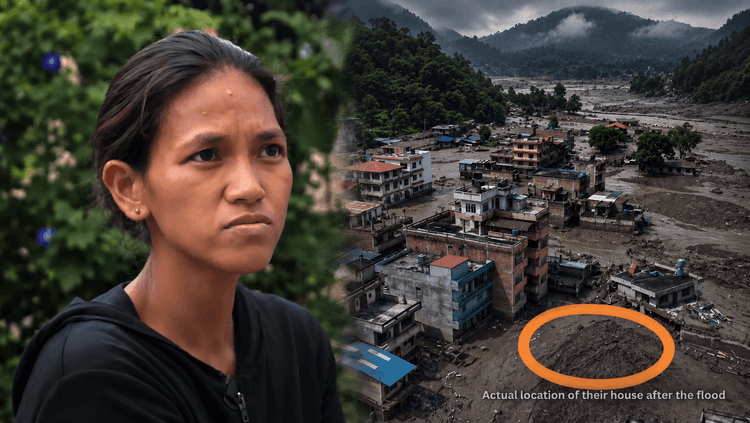
At the bottom, a hundred kilometers downstream, was Ruth Alao-Gataraj. With her were her two children: Filipino sa ina, Nepali sa ama.
Tatlo silang nakaligtas.
Her story begins with somebody shouting that the dam above had burst.
Ruth was on the second floor. Her house sat behind a blue house in Trishuli Bazar. Her two children were with her. Her husband was not — he works in another country. Her mother is in Rizal, almost 5,000 kilometers away.
She grabbed her children and ran.
"Paglabas po namin, ang dami pong taong nagsisiksikan," she said. "Nagtutulakan."
They climbed. Up, away from the river, with everybody else. And from up there, Ruth watched the water take the ones who did not climb fast enough.
That was August 26. She lived. Her children lived.
One thousand three hundred forty-two people did not.
Natunaw na yelo
The Langtang Lirung glacier broke that morning. What came down the valley was not a flood the way we know floods. It was ice and rock and mud and whole trees, moving faster than a person can run. It did not rise. It arrived.
Another 4,886 are still missing. That number has stopped moving, because there is nobody left to look for. Around 1.6 million people were affected. More than 8,000 houses are simply gone. Thirteen hydropower projects went down with the rivers, pulling 431 megawatts off Nepal's grid.
The debris ran about 100 kilometers down the Bhote Koshi and the Trishuli, through five districts — Rasuwa, Nuwakot, Dhading, Gorkha, Chitwan.
Isipin mo ang EDSA. Mula Monumento sa Caloocan hanggang Mall of Asia sa Pasay, 23.8 kilometro lang iyon.
Apat na beses ang haba ng EDSA. Iyon ang dinaanan ng putik.
O ganito: kung magsisimula ka sa SM North EDSA at magmamaneho pahilaga, aabot ka ng Clark sa Pampanga — at lagpas pa. Ang tagal ng biyaheng iyon, isipin mong walang matirhan sa buong haba niyon.
At hindi pa doon nagtapos ang tubig. Bodies were recovered 240 kilometers away, across the border in India. Ganoon kalayo ang Maynila hanggang Baguio.
Ang ilog ang naghatid sa kanila doon.
Nuwakot was one of the five hardest-hit districts. Bidur is its capital.
We went there.
Ang daan papuntang Bidur
You cannot drive straight into Bidur anymore. The bridges are gone. So we went the long way — up through Kakani, across Thansing, on mountain roads that make the worst stretch to Baguio look like EDSA on a good day. Narrow zigzag road. Loose gravel. Bumpy ride. Rock wall on one side, air on the other.
Every Filipino knows that drive. It is the drive to the barangay na na-cut off ng bagyo. In Nepal it only goes higher.
What waits at the end of it is rubble and silt. Meters deep, grey and flat and quiet, with rooftops poking out of it like something at low tide.
Saru Shrestha stood in front of where her lodge used to be. Shrestha Hotel and Lodge: a lifetime of work, a family's whole living. Rebika Chhetri of Himalaya TV translated for us. At the ruins of the Yangra, reporter Mar Gabriel did the standup. Further up the Trishuli corridor, Shyam Kadel and his Himalaya TV team brought us to a view of the hydropower station, which used to be a building and is now a shape.
NET25 has covered disasters for years from a desk in Manila. Bidur is the first one I stood inside.
Under that grey, somewhere, are people who were never found.
Nepal lost Rs 387.54 billion. Two-point-five-seven billion dollars.
Pero habang nakatayo ako sa putik, walang numerong pumapasok sa utak ko. Isa lang: paano kung sa akin at sa pamilya ko ito nangyari?
As I wrote in a previous article, you tend to rehearse your own death.
Read: Bangungot: Buried Alive in Nepal
Nepal is paying the price
In my exclusive interview with Finance Minister Swarnim Wagle, he explained what his country is actually paying for.
Nepal accounts for one-tenth of one percent of the world's greenhouse gas emissions. It burns almost nothing. It industrialized almost never. And yet its glaciers are the ones melting, its valleys are the ones filling with mud, and its people are the ones being counted.
One glacier took about a tenth of Nepal's entire economy in a single morning.
Nepal did not cause this. Nepal is paying for it.
And some rich countries — the ones whose factories and highways and airports actually did the warming — have yet to put money into the Prime Minister's Disaster Relief Fund.
Baka mas nauna pa sa kanila ang Iglesia Ni Cristo.
Ang Lingap
On September 10, in Kathmandu, the Felix Y. Manalo Foundation turned over a donation to that fund. Minister Wagle received it. Suraj Vaidya, Honorary Consul General of the Philippines to Nepal, was with us.
You can measure how seriously a country takes something by which doors it opens. In one week, ours opened wide: an exclusive interview with the finance minister. A courtesy call with the special adviser to the Prime Minister — the man who helped hold the ruling party together. A courtesy call with the Speaker of the House, in his own official residence. Dinner with a member of parliament. Much of it arranged by a good friend, the owner of Himalaya TV.
A small Philippine delegation, in a country still putting itself back together, and the government made time.
For some, that is the kind of help that makes the news. A national fund. A ministry.
And then something happened that does not usually happen.
Somebody asked about one woman.
Word reached the Church leadership that a Filipina was among the survivors — alone with two children, sheltering in her mother-in-law's small house because her own was gone. Representatives of the Felix Y. Manalo Foundation went to find her.
Kahit ang Filipino community sa Nepal ay nagulat. Hindi na kasi mararating ang lugar niya by land. Chopper lang. At ang bawat flight ay kailangang aprubahan ng Nepal army.
Hindi siya miyembro ng Iglesia Ni Cristo.
Hindi iyon tinanong.
They put the family in a hotel for a few days. Hot food. A clean room. "Na-relax-relax po kami," Ruth said. "Nawala po iyong mga worry."
Then they brought her to a grocery in Dhading district and told her to take what she needed.
At first she took things by the kilo. Small amounts. Careful amounts — the habit of somebody who has been counting.
"Kanina napansin ko, parang kilo lang yung gusto mong kunin," Bro. Montriville Boy of the INC told her. "Parang ayaw mong kumuha ng sako."
"Hindi po ako makapaniwala po," she said. "Ay, hindi po talaga ako makapaniwala."
She walked out with two sacks of the best rice in the store. Four to five months of food.
At hindi pa doon natapos.
From that store they took her to another. Then another. Not for rice this time, but for the rest of what a family needs when it has lost the house it kept those things in. Beginning with the milk.
Remember the milk. After the flood her child cried and cried from hunger, and there was nowhere left standing in Trishuli Bazar to buy any.
That day she carried it out in her arms.
There was cash as well — more than anyone had given her since the water came. "Aabutin po ng taon," she said. "Hindi ko po masasabi kung ilang taon, pero taon po, sigurado po."
Ang hindi niya natapos sabihin
She held herself together through all of it. The hotel, the rice, the money. She only broke near the end, when it was time to say goodbye.
"Pumunta po ako dito, wala pong family," she said.
Her husband's side loves her, she said. But it is not the same as family sa Pinas. Two years in Nepal. Namimiss niya ang nanay niya.
Asked if she had a message for home, she said what every Filipino abroad says when the worst has already happened: Buhay pa ako. Huwag po kayong mag-alala.
Then: "Salamat sa Diyos. At salamat po sa mga tumulong."
Ang Nepal na nakilala ko
Let me tell you about the country itself, because it explains something.
Hindi sila ma-epal sa Nepal. That is the first thing you notice. They are kind, and they have an amount of patience I am not used to. We traveled on narrow roads, with lots of motorcycles, and at times the traffic is heavy — and there is almost no road rage, and very few accidents. Bawal ang horn. Bawal magputol ng puno.
There is not much infrastructure. Even the airport looks like a domestic terminal to Filipino eyes.
And this is a country in the middle of changing itself. Nepal had just come through the Gen Z protests that brought down its government — young people in the streets, burning the symbols of power and corruption they had grown up under.
So picture the full situation. A nation that had just overturned its own leadership. Thin infrastructure. Five districts under mud. A world that has not sent its share. And into that, a delegation from a country almost 5,000 kilometers away, carrying care packages up a broken mountain road.
I joined the Care for Humanity mission during the distribution. I saw the resilience of the Nepalese up close — people who had lost everything, standing in line without pushing, saying thank you in a language I do not speak.
Wala silang utang sa atin. Tiyak kong wala ni isang botante sa Bidur ang boboto sa halalan natin.
Hindi rin iyon ang tanong.
Presensiya, hindi pera
On the way home, I noticed something, and it took the whole drive to the airport before it sank in.
Everyone said the same thing. The government officials in their offices. The workers at the hotel. Even the driver taking us to our flight.
They were thankful.
Pero hindi iyon ang paulit-ulit nilang sinasabi.
Ang pinasalamatan nila ay ang pagpunta namin. Na may umakyat sa sirang daan. Na may nagpakita.
Hindi pala ang pera ang pinakamalaki sa kanila. Ang malaman na may nakakaalala sa kanila.
At doon ko naintindihan ang direktiba na isinagawa ng FYM Foundation. Hindi lang tulong ang ipinadala. Ipinadala pati ang tao.
Kasi ang pera, kahit saan mo pwedeng i-wire. Pero para maramdaman ng isang bansa na may nagmamalasakit sa kanila, kailangan mong pumunta doon.
Care for Humanity
This is the part that is easy to miss, so let me say it plainly.
Ruth is not a story about one lucky woman.
What reached her has a name and a machinery behind it. Care for Humanity is the flagship program of the Felix Y. Manalo Foundation, the humanitarian arm of the Iglesia Ni Cristo. Food assistance. Medical missions. Livelihood. Hygiene kits. Scholarships. Housing. Disaster response.
Hindi siya eksepsiyon. Iyon ang ginagawa nila, araw-araw, sa mga lugar na hindi umaabot sa balita.
Balikan natin ang Setyembre 2009. Hinagupit ng Ondoy ang Metro Manila.
The relief began on September 27, the day after the flood. Marikina. San Mateo. Rodriguez. Then Bulacan, Nueva Ecija, Pampanga, Cavite, Laguna, Batangas. In San Mateo and Rodriguez alone, 2,400 families. Pagkain, damit, tubig — sardinas, noodles, kape, bigas, nakabalot sa plastic.
And then in November 2013 came Yolanda. A barge carried 17 trucks into Tacloban. More than 100,000 families received relief packs — four kilos of rice, noodles, canned goods — with free checkups, medicine and vitamins for the elderly and the infants. It was run through Lingap sa Mamamayan and the Felix Y. Manalo Foundation.
Ang parehong foundation na nag-abot ng tulong sa Kathmandu.
And they did not leave when the cameras did. In March 2014 they broke ground in Leyte on more than 1,000 housing units, with garment factories and eco-farming, for survivors who had nothing to go back to. Ang lugar na iyon ay may pangalan na ngayon: Sitio New Era.
Then September 30, 2025. A magnitude 6.9 earthquake under Bogo City, Cebu. More than 9,000 aftershocks. Fifty-three cities and towns under a state of calamity. Within a week, 10,000 relief packs of rice and canned goods moved through the Bogo City and Cebu City districts.
Wala pang isang taon bago ang Nepal.
At hindi lahat ay sakuna. Noong Setyembre din ng 2025, tumulong ang Care for Humanity sa mga international student at bagong dating sa siyam na lungsod sa Canada. Walang bagyo doon. Nangailangan lang ng tulong ang mga tao.
And last October, the Worldwide Lingap sa Mamamayan ran in more than 160 countries and territories at the same time — Africa, Oceania, South America, Asia, North America, Europe. Medical missions. Relief goods. Food packs. Livelihood support. Hygiene kits. Water pumps in Malawi and Uganda. Villages most people cannot find on a map.
Ngayon, isipin mo kung gaano kalawak ang mga proyekto ng isang Iglesiang nasa mahigit isandaan at animnapung bansa. Mga usaping hindi na kasya sa isang artikulo.
Pero kahit gaano karami ang gawain, may isang bagay na hindi nakakaligtaan: ang paglingap kapag may kalamidad.
Hindi ito naipagpapaliban. Walang mas malaking usapin na pumapalit dito. Pagbaha sa Marikina, lindol sa Bogo, o isang bundok na bumagsak sa Nepal — ganoon pa rin ang sagot.
The same thing keeps happening in the same shape. The big turnover and the small one. The government fund and the two sacks of rice. The country and the woman.
Most institutions can manage the first. Very few bother with the second, because the second does not scale, does not photograph well, and saves nobody any money.
That is the defining moment I went to Nepal to see, although I did not know it when I boarded the plane.
Ang isa at ang marami
There is an old way to measure how much anyone actually cares. Do they go back for the one?
Ruth Alao-Gataraj spent eight years as an OFW in Malaysia. That is where she met her husband. That is how a woman from Rizal ended up on a second floor in Trishuli Bazar with two children and a mountain coming down.
Hindi siya kilala.
Hindi siya mararating by land.
Hindi siya miyembro ng Iglesia Ni Cristo.
Hinanap pa rin siya.
She said it herself: wala pong family.
She was wrong about that. It took a broken road, a helicopter, an army clearance, and many years of habit to prove it to her.
Hindi ko naman ini-epal. Pero buti na lang, nakarating ako sa Nepal.
At doon ko nakita kung gaano kalayo ang kayang abutin ng malasakit.
Kahit sa bansang kinalalagyan ng pinakamatataas na kabundukan.