MANILA — A customer walks into a store. She did not find it on Facebook. She did not find it on Google. She found it because an AI told her to go there.
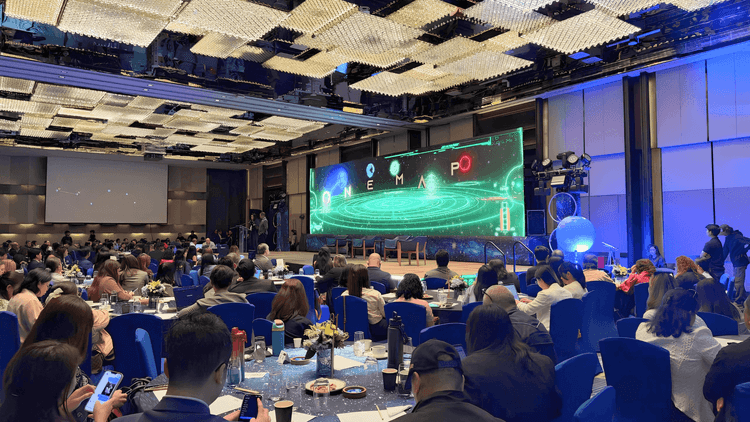
That story opened the 55th PMA Marketing Conference, themed “One Map,” held September 23 at Hilton Manila, Newport World Resorts.
“Where do customers find you?” asked Cha Pestano-Diaz, director of the 2026 conference. “Because the answer changed again while we were all busy figuring it out.”
Pestano-Diaz laid it out plainly. Attention is scarce. Budgets are tight. Trust “takes longer to earn and just one second to lose.”
Now there is “a machine sitting between you and your customer,” she said. It helps them search. It helps them compare. It helps them choose.
“Some of you feel like you’re steering through a storm,” she said. “What saves you is not speed. It’s orientation.”
Every Filipino who has lived through a typhoon knows this. You don’t run blindly. You find your bearings first.
She asked attendees to leave with six lines on their own “map”: where their customers are going, who they need to move, what signal they will watch, what they will do faster, what they stand for, and what their plan is when the storm hits.
Cheap to make, costly to believe
Roger Wang, first vice president and incoming 2027 president of the Asia Marketing Federation, took the stage. He did not bring good news.
AI has made content almost free. A video that once needed a director, actors and a full crew can now be made by one or two people.
But cheap has a hidden cost. Wang pointed to Coca-Cola’s AI-generated holiday ads. The brand saved a fortune making them. Netizens complained in 2024, then complained even louder in 2025.
“They paid somewhere else,” Wang said.
And when every company uses the same AI tools, nobody gets ahead.
“If everyone has it, that is not an advantage,” he said.
The front door is closing
For years, businesses poured money into websites and search rankings. Now, Wang said, 68% of Google searches end with no click at all. Search traffic is down 22% from a year ago. AI answers at the top of the page cut clicks by more than 60%.
People no longer scroll through results. They just ask an AI for the top three.
“The front door of your business is closing,” Wang said, “and no one sent you a letter.”
Trust cannot be generated
Wang cited companies that went “AI first” and regretted it. One financial firm replaced about 700 customer service staff with AI, saw service quality drop, and hired people back. Language app Duolingo faced a fierce online backlash after its own AI-first announcement.
Trust, he said, now ranks alongside quality and price as a top reason people buy.
“Trust is something that cannot be generated, only earned,” Wang said.
He named what machines cannot copy: trust, knowing your own customers, live events where “no one is scrolling,” and taste. When everyone can make the same content, he said, knowing what not to make becomes the real skill.
Purpose is not a CSR program
Margot Torres, managing director of McDonald’s Philippines, agreed that trust is earned over time. But she said it starts inside the company, not in the ad.
“Know what you stand for. Know your purpose and live it every day,” Torres said.
“Purpose is not a CSR program. It is not a campaign theme nor a statement on your website. Purpose is the reason your organization exists.”
She put a simple question to the room: Who would you trust? A company with a great CSR program that doesn’t pay its workers overtime? Or one with no CSR program that pays and treats its people well?
“Trust cannot possibly belong to marketing alone,” she said.
Torres said McDonald’s has not used contractual hiring since 1981. About 70% of its crew are working students. Broadcast journalist Rico Hizon started as one of them.
She also recalled Daniel Cabrera, the boy who went viral doing homework under the light of a McDonald’s store in Cebu. He later received a scholarship and has since graduated from high school with honors.
During the pandemic, Torres served as communications lead for Task Force T3, where rival companies worked together to help Filipinos return safely to work.
“While brands may compete for growth, market share, revenue, we all benefit when our communities prosper,” she said.
Her closing line: “Stay true to your purpose. Build trust. Create impact, and the business will follow.”
Seven departments, one customer
Jos Ortega, chairman and CEO of Havas Media Ortega and a former PMA president, challenged a popular idea in marketing: that every customer journey should be seamless.
“Seamless is invisible, and invisible is forgettable,” he said.
Filipinos no longer take a brand’s word for it, Ortega said. They screenshot. They fact-check. They ask the group chat before they believe you.
“You can be perfectly efficient and still be quietly disbelieved.”
Inside most companies, he said, marketing, sales, operations, finance, customer service and store staff each handle a piece of the customer. Seven departments, one customer. And the customer doesn’t care about your org chart.
“Everybody owns their slice of the transaction,” Ortega said. “Nobody owns whether the customer still believes you.”
He warned against rushing AI into weak customer relationships.
“AI will not fix a broken relationship. It will fail your customer faster, at scale, on every channel, all at once.”
His fix was small. One retail client found that store staff never knew what customers had asked on Facebook. So they gave the counter a shared inbox. Six months later, purchases from customers who first messaged online rose 41%.
“Not because we ran a better campaign,” Ortega said, “because we stopped making them start all over again.”
His challenge to every marketer: find one moment where your customer has to start over, and fix it.
“That’s where trust starts coming back.”