
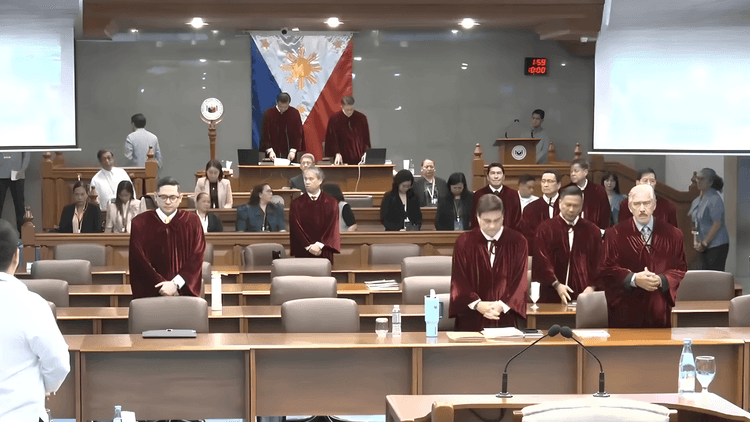
July 20, 2026 | Senate Impeachment Court, Pasay City
The Senate impeachment court declared a quorum at 2 p.m. to open Day 7, with 21 of 24 senator-judges physically present. Absent were Senator Bato dela Rosa, who remains in hiding over an International Criminal Court arrest warrant tied to the Duterte-era drug war; Senator Jinggoy Estrada, detained and suspended over a plunder case; and Senator Rodante Marcoleta, who had surrendered to authorities on a separate plunder complaint.
The day's business picked up where Day 6 left off: a ruling on the prosecution's motion to subpoena the bank, tax, and Anti-Money Laundering Council (AMLC) records of the Vice President and her husband, Atty. Manases Carpio — documents sought for Article II of the Articles of Impeachment, which accuses her of unexplained wealth and an inaccurate Statement of Assets, Liabilities and Net Worth (SALN). But before that, the court spent its opening stretch on a different fight altogether. Here are the highlights of Day 7:
Padilla, Tulfo, Cayetano clash over off-topic manifestations
The session opened not with the subpoena motion but with Senator-Judge Robin Padilla raising a personal manifestation to deny reports that he had ignored an Office of the Ombudsman directive to file a counter-affidavit, in a complaint linked to his alleged assistance in Senator Bato dela Rosa's supposed “escape.” Holding up what he said was his original filing, Padilla insisted he had complied with the Ombudsman's order and objected to media reports suggesting otherwise, while maintaining he does not recognize the jurisdiction of the International Criminal Court.
That drew a challenge from Senator-Judge Erwin Tulfo, who questioned whether the impeachment court was the proper venue for senators to air personal legal matters. “Every minute, every hour that we waste away from the defense or from the prosecution of the case of the Vice President, it is injustice to the Vice President,” Tulfo said, urging colleagues to raise such issues instead through press conferences, social media, or regular Senate sessions, and appealing to Presiding Officer Chiz Escudero to keep proceedings strictly focused on the impeachment complaint.
Senate Minority Leader Alan Peter Cayetano pushed back, arguing that the integrity of senator-judges is always relevant to the trial because it bears on the credibility of the tribunal itself. He said the court's constitutional duty was neither to prosecute nor to clear the Vice President, but to hear the evidence and decide whether to convict or acquit.
Senator Vicente Sotto III moved to refer the manifestations to the Senate sitting as a legislative body rather than to the impeachment court, a motion Senator Francis “Kiko” Pangilinan backed by invoking a similar precedent from the 2001 Estrada impeachment trial. Escudero adopted that approach — Padilla's manifestation would remain part of the impeachment court's record but be referred to the Senate as a legislative body — while noting that the ongoing Senate recess had left the court as senators' only shared venue to raise such concerns until Congress resumes after the SONA. “I ask the indulgence of the parties to this case,” Escudero said.
Impeachment court grants the subpoena — on what basis
After the senator-judges took up the motion left pending since Wednesday's caucus, the impeachment court granted the prosecution's request to subpoena Duterte and Carpio's bank, tax, and AMLC records. Impeachment court spokesperson Atty. Reginald Tongol had earlier clarified that only senators present on Monday could vote, with a simple majority — 11 of the 21 present — needed to carry the motion.
The ruling turned on the prosecution's argument that impeachment proceedings are a recognized exception to the country's confidentiality laws. Under the Law on Secrecy of Bank Deposits (RA 1405) and the Anti-Money Laundering Act, disclosure is barred except in specific cases — and an order from a competent court in a pending impeachment case is one of them. The prosecution also invoked the 2012 trial of then-Chief Justice Renato Corona, where the Senate impeachment court subpoenaed his bank records on the same legal basis, and argued that the National Internal Revenue Code does not shield tax records from an impeachment court's request. Rep. Chel Diokno, arguing for the panel, had framed it during Day 6's oral arguments as a matter of the court's constitutionally exclusive power to try impeachment cases — a power he said “includes the power to uncover the whole truth.” The records are being sought to support Article II of the Articles of Impeachment, which accuses the Vice President of unexplained wealth and a SALN that does not match the roughly ₱6.7 billion in covered and suspicious transactions the AMLC linked to her and Carpio in an April House hearing, against her declared ₱80-million net worth.
Defense: don't set the law aside — Poa
Continuing the argument he raised on Day 6, defense counsel Atty. Michael Poa insisted the court should not set aside existing confidentiality laws in the name of transparency and accountability, maintaining that due process must govern how the records are obtained even as the panel pursues the truth.
Pia Cayetano presses prosecution on legal basis
Senator-Judge Pia Cayetano formally questioned the prosecution on the legal basis for releasing the Vice President's financial documents in connection with the unexplained wealth allegations — echoing the concerns about process she raised during Day 6's arguments.
Drilon: bank secrecy law doesn't apply here
Weighing in from outside the chamber, former Senate President Franklin Drilon told radio listeners that bank and tax records are exempted from confidentiality laws when sought for an impeachment trial, pointing to the precedent set when the Senate subpoenaed then-Chief Justice Renato Corona's bank records in 2012. “Ang exemption ay ang impeachment trial... dahil ang impeachment trial ay isang paraan kung saan pinasagot ang mga impeachable officials sa mga pagkukulang, o corruption,” Drilon said.
Prosecution: financial gap remains the core issue
House prosecution spokesman Benjamin Tolosa reiterated that the case does not rest on the financial records alone, but called them among the strongest evidence available. He said the defense's resistance to voluntarily disclosing the records “raises serious questions” about what they might show.
Prosecution defers to Escudero on Matibag's testimony
Ahead of NBI Director Melvin Matibag's scheduled appearance Tuesday as the last prosecution witness under Article IV, the prosecution panel said it would leave it to presiding officer Senate President Chiz Escudero to screen which questions are appropriate — a response to concerns raised after Senator Alan Peter Cayetano's “minion” remark about Matibag. Prosecution spokesman Jay Tolosa teased the testimony, saying Matibag is expected to shed light on the Vice President's alleged remarks about having hired an assassin to kill President Marcos: “You wouldn't want to miss his testimony tomorrow.”
Rally outside the Senate
Advocacy groups gathered outside the Senate building Monday, calling on the court to subpoena and unseal Duterte's bank and tax records.
What Happens Next
The impeachment court adjourned at 5:51 p.m. NBI Director Melvin Matibag takes the stand Tuesday, July 21, as the prosecution's final witness under Article IV. The defense has said it is ready to cross-examine him. Trial resumes at 2 p.m.
Previous Trial Days
• Day 1 (July 6): The Senate formally convened as an impeachment court; Sen. Chiz Escudero was elected presiding officer, ruled that 16 votes are needed to convict, and both panels delivered their opening statements.
• Day 2 (July 7): The prosecution opened its case on Article IV; first witness NBI Senior Agent John Mark Calilung authenticated videos of the Vice President's November 2024 “kill” remarks, and prosecutors bared plans to call the Vice President herself as a hostile witness.
• Day 3 (July 8): The defense cross-examined Calilung, who admitted no personal knowledge of any alleged hitman; the court granted subpoenas for OVP Chief of Staff Zuleika Lopez, while prosecutors sought the Vice President's bank and tax records.
• Day 4 (July 13): NBI's Atty. Jeremy Lotoc testified the alleged threats were “real” and “serious” and not covered by free speech; “Operation Romanov” took center stage, with the NBI admitting it found no validated information on the alleged hitman.
• Day 5 (July 14): Lotoc completed his testimony after the warning-versus-threat debate; the prosecution dropped Lopez and Bello as witnesses and shifted its sights to the Vice President's financial records.
• Day 6 (July 15): Financial records and subpoena requests took center stage as both panels argued over bank and tax secrecy; the court set its ruling for July 20.
• Day 7 (July 20): The session opened with a clash over Sen. Robin Padilla's off-topic manifestation on an Ombudsman matter, referred to the Senate as a legislative body; the impeachment court then granted the subpoena for the Vice President and Atty. Manases Carpio's bank, tax, and AMLC records. NBI Director Melvin Matibag is set to testify July 21.