On the night of June 27, 2026, the loudest sound inside the Philippine Arena was not a guitar riff or a drumbeat. It was the sound of forty-something Filipinos screaming the way they did when they were teenagers, because for one night, they were.
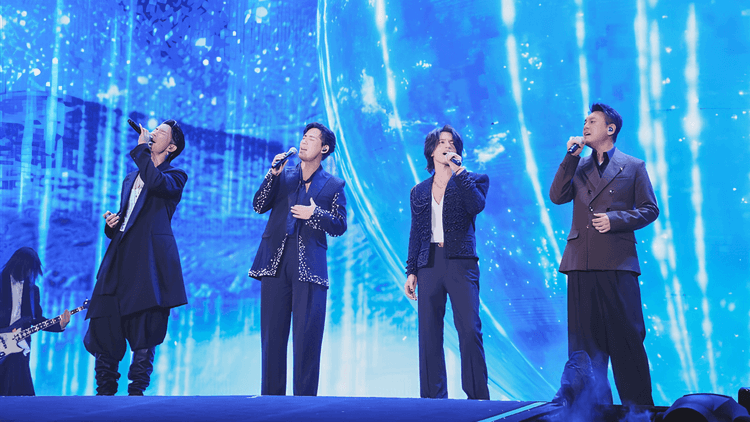
Long before K-pop conquered the world and P-pop became a homegrown sensation, there was F4. The Taiwanese pop quartet that an entire Filipino generation grew up loving opened its “F FOREVER” 1st World Tour in Bulacan, choosing Manila as the very first stop on a global run. Jerry Yan, Vanness Wu and Vic Chou took the stage of the Philippine Arena, the world’s largest indoor arena, joined by Ashin, frontman of the rock band Mayday. Tickets had ranged from ₱1,500 for general admission to ₱21,500 for premium floor seats, and they moved fast. The fans who bought them were not children.
Where it began: “Meteor Garden fever”
To understand the screaming, you have to go back about 25 years. F4, short for “Flower Four,” was born not as a band but as a cast. In 2001, a Taiwanese television studio adapted the Japanese manga Hana Yori Dango (Boys Over Flowers) into a drama called Meteor Garden. The story was simple and irresistible: Shan Cai, a poor but fierce scholarship student, collides with four impossibly rich, impossibly good-looking boys who rule her elite university: the arrogant heir Dao Ming Si, the brooding Hua Ze Lei, and their friends Mei Zuo and Xi Men. She refuses to be bullied. He falls in love. The country fell with him.
A word on the math, because the anniversaries blur together: F4 and Meteor Garden both date to 2001 in Taiwan, which makes 2026 the group’s 25th year, the milestone the tour itself is built around. Filipinos, though, met them a little later. The Tagalog-dubbed series aired on local television from May to July 2003, and F4 first performed for Filipino fans that same year. So for the local audience, this reunion lands closer to two decades, roughly 23 years, since the fever first took hold. Both numbers are true; they just measure from different starting lines.
And take hold it did. When the dubbed version aired in 2003, it did not just rate well. It became a phenomenon. Local media gave it a name: “Meteor Garden fever.” It was one of the highest-rated programs on Philippine television at the time, and it kicked open the door for the wave of Asianovelas (Taiwanese, Korean, and beyond) that would dominate local airwaves for the next two decades. Barbie Hsu, who played Shan Cai, became so beloved that Filipinos kept calling her by her character’s name for years afterward. So did the boys. The devotion ran deep enough that some parents named their children after the characters: little Shan Cais and Si’s scattered across a generation of birth certificates, a small, permanent monument to a TV show. One friend of our team named her daughter Ayesha, after Ye Sha, the character played by Michelle Saram in the 2002 sequel, Meteor Garden II, the very woman who came between Dao Ming Si and Shan Cai. Onscreen she was the rival; offscreen, the name stuck, proof of just how thoroughly the series wove itself into Filipino family life.
How old they were, and how old they are now
Part of what made the reunion so emotional is the simple arithmetic of time. When Meteor Garden was filmed, F4 were barely out of their teens and early twenties: Jerry Yan was about 24, Vanness Wu around 23, Ken Chu about 21, and Vic Chou the baby of the group at roughly 20. They were boys playing boys.
A quarter-century later, they are grown men. As of this tour, Jerry Yan is around 49, Vanness Wu and Ken Chu are in their mid-to-late 40s, and Vic Chou is about 45. The reunion carries an ache, too: Barbie Hsu, the Shan Cai to their F4, died in February 2025 at the age of 48 from complications of pneumonia, lending the whole tour the weight of a tribute. And the lineup itself is bittersweet for purists: original member Ken Chu is not part of this world tour, reportedly never signed for the project amid unresolved differences with concert organizer B’in Music. Three of the four flowers, then, but enough to bring the room to tears.
The audience: the titos and titas of Manila
Do the math on the fans, too. The teenagers who rushed home from school in 2003 to catch the dubbed episodes are now somewhere between their mid-30s and late 40s, the titos and titas of Manila. They came to the Arena as professionals, as parents, some with their own kids in tow. And what struck many observers was the temperament of the crowd. This was not a chaotic mob. It was a remarkably chill, well-mannered audience. No shoving, no pushing, just a sea of grown adults who were, for a few hours, completely at ease and completely transported. Cool, even. The composure of people who have nothing left to prove and everything to feel.
Our team saw that composure up close. Near the VIP section, a beautiful, slim woman in her late forties was stopped at the entrance. Her ticket, the usher explained, may not have been properly stamped and might be missing whatever step it needed to clear her into the VIP area. He pointed her back the way she came: all the way to the front, to have her credentials processed. There was no scene, no argument, no name-dropping, none of the entitlement an evening like this can sometimes summon. She simply nodded and went. A few minutes later she returned, paperwork sorted, and walked in without a word. A very classy Tita, and, in a single small gesture, the whole temperament of this crowd.
There was a gentler moment, too. Sometime later, a Tita in her early 50s, having perhaps stepped out to the restroom, could not find her way back to her seat, moving from one row to the next, an usher accompanying her patiently all throughout the search. She turned to our team and asked, “Dumaan ba ako dito?” The honest answer was “Hindi po.” No frustration, no fuss; just a woman briefly lost in a sea of strangers who all, more or less, came for the same reason she did, with an usher staying right at her side until she found her seat. Credit goes to the Philippine Arena staff for that. Small, attentive courtesies like it, repeated across a crowd of tens of thousands, are exactly what kept the evening calm and every Tita and Tito feeling looked after.
That is not to say it was quiet. When the opening notes of the old theme songs hit, the screaming was immediate and total, the muscle memory of fandom, intact after 25 years. And the loudest screams of the night belonged to one man: every time Jerry Yan, the Dao Ming Si who broke and mended a generation of hearts, flashed onto the giant screens, the Arena erupted, a roar that left no doubt about who the crowd had come home for. And the emotion ran both ways across the barrier: some of the performers themselves were visibly teary-eyed on stage, blinking hard and steadying their voices as they took in a room that had waited a quarter-century for this night. Scanning the crowd, the room was clearly not all one age, either. Among the titos and titas were plenty of younger faces: millennials who were slightly too young the first time, and Gen Z fans who discovered Meteor Garden through reruns, streaming, and their parents’ nostalgia. A boy band born in 2001 now plays to three generations at once.
And some Titas got remarkably close. As the performers worked the edges of the stage and the runways, fans pressed forward, a few near enough to reach out, and several simply handed their phones over to Jerry Yan, their Dao Ming Si, and let him take the selfie himself. He obliged patiently, over and over, snapping shot after shot before passing each phone back to its starstruck owner. For women who had spent two decades loving him from the other side of a television screen, the distance had finally closed to arm’s length.
The celebrity nostalgia trip
The fandom spilled over into the local celebrity world in the run-up to the show. Actress Ellen Adarna leaned fully into the nostalgia, posting a video of herself lip-syncing to “Jue Bu Neng Shi Qu Ni,” one of the Meteor Garden theme songs, and tagging all four original F4 members; Ken Chu noticed and engaged, sending her into a delighted fangirl spiral. That warmth showed up in person, too: our team saw Adarna at the doors graciously allowing concertgoers to take selfies with her as they streamed in, a star happy to be just another fan among fans. Former beauty queen and volleyball star Michelle Gumabao was among the recognizable faces drawn into the F4 moment as well. Their reactions tracked the larger story precisely: these are accomplished adults in their 30s and 40s, briefly and happily reduced to the teenagers they were when Shan Cai first stood up to Dao Ming Si.
A complex with a second act coming
And the same grounds have an even bigger night waiting, three of them, next year. BTS will bring the finale of its “Arirang” World Tour to the adjacent Philippine Sports Stadium on March 13, 14, and 16, 2027, the K-pop superstars’ first Manila dates since completing their military service. Demand ran so hot that a third night was added after the first two sold out. It makes for a neat generational handoff on a single patch of Bulacan: the band that introduced Filipinos to the East Asian pop wave some two decades ago, and the band that now defines its global peak. F4 this June, BTS next year, and, knowing the Philippine Arena, plenty more in between. The complex rarely stops surprising, booking act after act through the months that separate the two. It has quietly become the home stage of the live-entertainment wave in the country, and that wave is clearly far from done cresting.
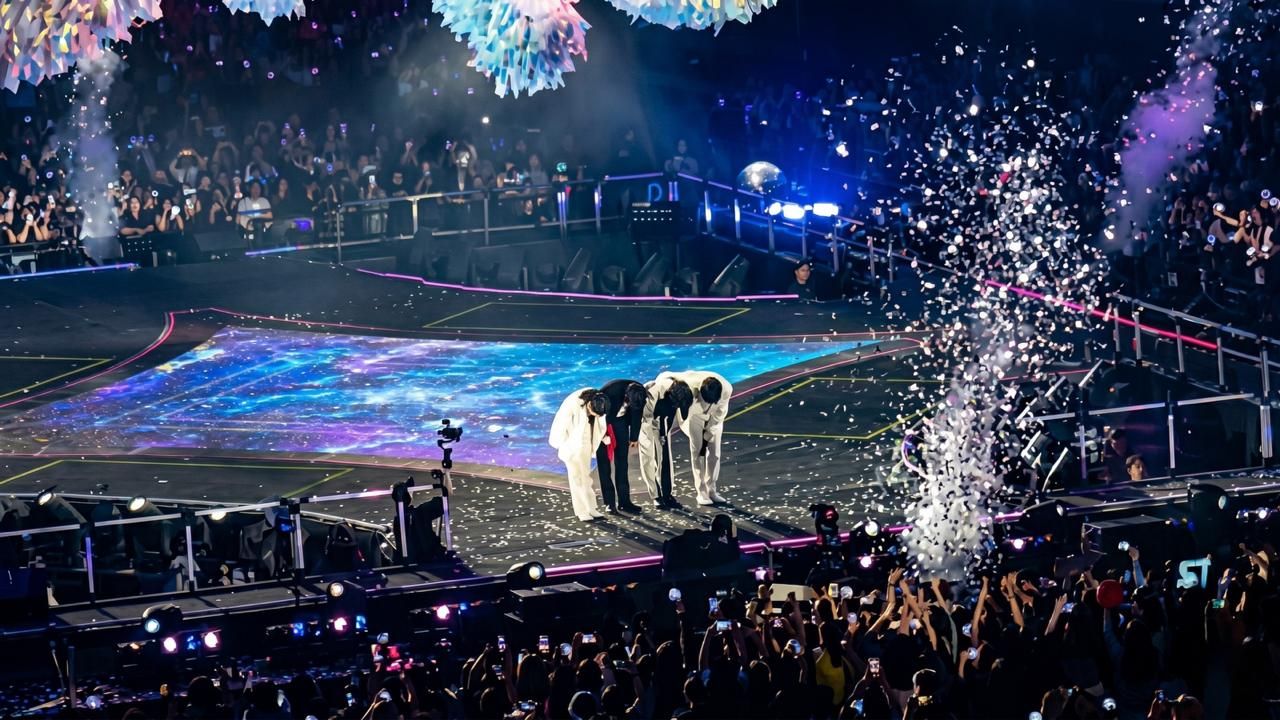
For the titos and titas who filled the Arena on June 27, that symmetry is almost beside the point. They did not come for a cultural thesis. They came to be 14 again for a couple of hours: to scream, to cry a little for Barbie, and to find out that the boys they loved grew up alright, and so did they.