The Philippines is a country that argues about almost everything. We have never been this polarized. Politics splits families at the dinner table. Even traffic complaints turn into shouting matches online. But for a few weeks this July, one name managed to unite the noise instead of adding to it: Alex Eala.
The 21-year-old from Quezon City has done what no Filipino tennis player has ever done.
Eala closed out 2025 at a career-high No. 50 in the world, the first Filipino to ever break into the WTA Top 100. By March 2026, she had climbed to No. 29. A brief dip followed, but she answered it by winning the Birmingham Open, her second WTA 125 title, which pushed her back up to No. 33 heading into Wimbledon as the tournament’s 32nd seed.
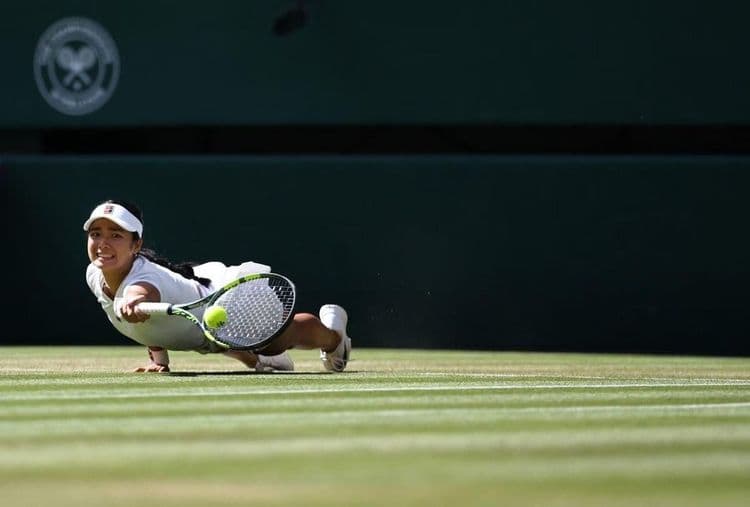
Then came the run that changed everything. Eala opened with a straightforward win over Mexico’s Renata Zarazua, survived a three-set battle against Australia’s Maya Joint, and then, in the third round, produced the upset of the tournament: a 7-6(9), 6-2 win over defending champion Iga Swiatek. It marked the first time a Filipino had reached the second week of a Grand Slam, and projections had her climbing to a new career high near No. 28 as a result.
“I don’t care anymore about the results,” Swiatek said afterward, a rare admission from a former world No. 1 about the level Eala had just played.
The win did more than move a ranking number. It moved an audience. Wimbledon’s Royal Box that day included Tom Hiddleston, Andrew Garfield, Anna Wintour, Emma Corrin, and Michaela Coel. On Wimbledon’s own social media, tennis great Maria Sharapova, boxing legend Manny Pacquiao, singer apl.de.ap, and talk show host Chelsea Handler all left congratulations. Eala later met Kate Middleton. Billie Jean King, one of the sport’s most decorated champions, called her an inspiration “for kids in the Philippines and all over the world.”
Back home, the reaction was just as immediate. Ogie Alcasid, Ryan Agoncillo, Anne Curtis, Janine Gutierrez, Drew Arellano, Dimples Romana, and Eugene Domingo all posted their congratulations within hours of the win. Alcasid summed up what many were feeling, praising her “grit, humble confidence, and undeniable grace.” Pacquiao, watching from wherever a boxing icon watches tennis, offered his own praise.
That last detail is not a coincidence. The parallels between the two athletes run deeper than a shared nationality and a shared moment of celebrity applause.
Pacquiao was one of six children raised in a single-parent household in Bukidnon, so poor that meals sometimes went without rice. He dropped out of school at 10 to help support his family, and by 15 he had made his way to Manila alone, at times stowing away on boats, chasing a boxing career with no guarantee it would lead anywhere.
Eala’s path started differently but demanded a similar toll. She picked up a racket at four, coached first by her grandfather, Roberto “Lolo Bob” Maniego. A win at the Les Petits As tournament at age 12 earned her a scholarship to the Rafa Nadal Academy, and at 13 she left her family and her country behind to train in Mallorca, Spain. While her peers spent weekends with friends, she spent hers on repetitive drills, alone in a foreign country, chasing something no Filipino had done before.
Different circumstances, same throughline: both left home too young. Both traded ordinary childhoods for years of unglamorous repetition, far from anyone who loved them. Both had one early believer, an uncle in Pacquiao’s case, a grandfather in Eala’s, who saw something worth pushing. And both eventually turned that sacrifice into something an entire country could rally behind.
What is there to learn from her, beyond the scoreline? Humility, first. Even after beating a defending Wimbledon champion, Eala’s instinct was to credit her team and her family, not herself. Discipline, second, the kind that was built years before anyone was paying attention. Grace under pressure, third, evident in how composed she stayed on the sport’s biggest stage. And perhaps the clearest lesson of all: quiet consistency travels further than noise. In a country that argues about everything, nobody argued about Alex Eala. Everyone, regardless of where they stand on anything else, was simply cheering.
Pacquiao gave the country a reason to stay up until 3 a.m. for a fight. Eala is giving it a reason to check the score before breakfast. Both came from very little. Both walked into rooms no Filipino had entered before. And both, for a moment, made the loudest, most divided country shout the same cheer.
That is the title this piece started with, and it was never just a headline. Manny Pacquiao gave the Philippines a reason to believe one fight at a time, until an entire nation, regardless of class or politics, stopped what it was doing to watch one man punch above his circumstances. Alex Eala is doing the same, one match at a time, on a court no Filipino had ever reached this far into.
She is not simply the country's newest star. She is the Philippines' new Manny Pacquiao.
📷: Reuters