
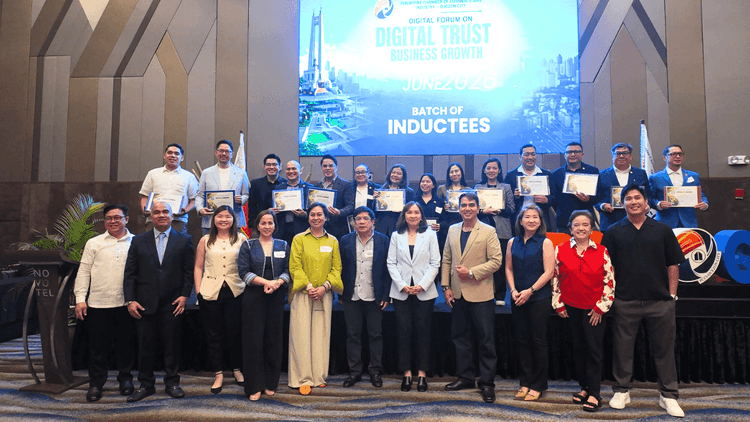
Cybersecurity can no longer sit with the IT department alone. It must start at the top of the organization and reach every employee, partner, and customer.
That was the consensus of the panel at the PCCI-Quezon City forum on digital trust, which brought together fintech, banking, anti-scam, and legal technology experts to discuss the vulnerabilities businesses face and the practical defenses available to them.
The panelists agreed that in most large organizations the back-end systems are already well protected. The weakest links, they said, are people, customer-facing channels, and the document layer.
Jocel De Guzman of ScamWatch PH and Truth360, speaking from the consumer protection and public awareness side, distilled the behavioral risks into simple rules the public can follow: protect personal information, treat offers that seem too good to be true as red flags, limit interactions with strangers online, and report incidents through the national anti-scam hotline 1326. He noted that fewer than two percent of businesses report incidents despite high attack volumes, which weakens collective detection and takedown efforts.
Marlon Umali of City Savings Bank, representing the banking sector, pointed to a coming shift away from SMS one-time passwords toward in-app authentication and biometrics, driven by regulatory change under Republic Act 12010 and related payment-service upgrades. Businesses, he advised, should expect app updates and stronger identity checks in the near term.
Josh Quinto of PayMongo addressed digital payments, risk, and compliance as more merchants move to cashless transactions. He described how a secure payment gateway can combine two-factor authentication, real-time transaction visibility, and machine-learning fraud scoring that flags high-risk transactions for merchant review. He also outlined a recovery playbook for businesses hit by fraud, built on immediate reporting, credential resets, and transparent, repeated communication with government, partners, and customers.
Atty. Third Bagro of Twala turned the discussion to the document layer. Forged deeds and contracts remain a powerful fraud vector, he said, and pointed to blockchain-backed digital signatures and e-notarization as a way to secure documents and enable safe remote transactions. He highlighted the benefit to overseas Filipino workers, whose remote signings often face authenticity challenges.
The forum formed part of PCCI-QC’s broader push to help entrepreneurs grow and innovate while protecting their businesses, customers, and transactions from digital risks, an effort organizers tied to the reality that trust has become part of the cost of doing business in the digital economy.