
The country continues to witness terrible scenes as Mindanao tries to recover from the destruction caused by Monday's 7.8-magnitude earthquake.
The death toll has climbed to 55, rescue teams remain on the ground, and thousands of families are facing the difficult reality of rebuilding their lives from ruins.
Yet amid the collapsed buildings, shattered roads, and twisted steel, one structure has become impossible to ignore.
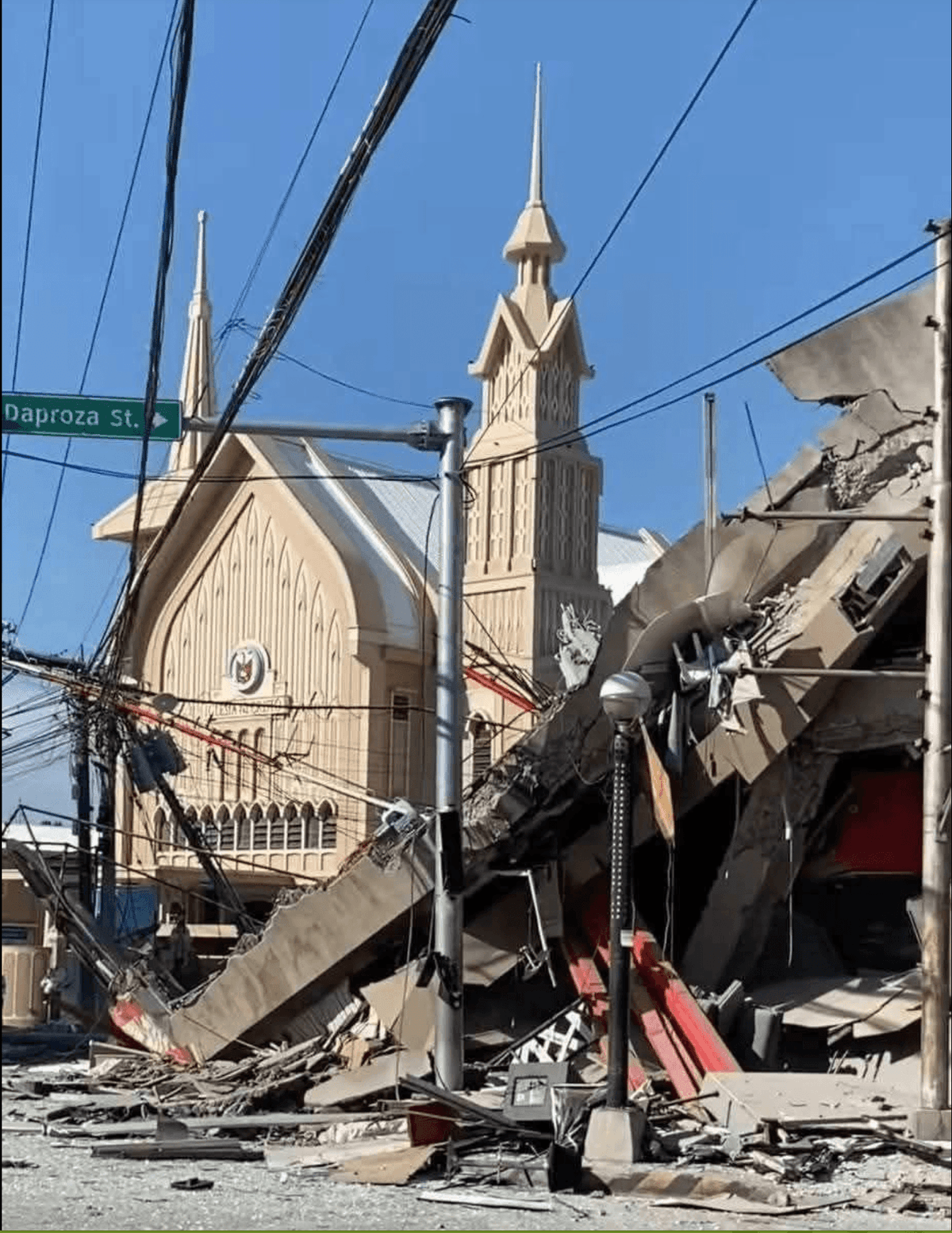
In General Santos City, eyewitness footage captured the horrifying collapse of a commercial building housing a Jollibee restaurant and a local radio station.
Within moments, the structure crumbled, leaving hundreds injured and countless others traumatized.
Standing beside it, however, was an Iglesia Ni Cristo house of worship.
Virtually untouched.
Its towering spires remained intact. Its walls stood firm. While destruction surrounded it, the Church appeared to have weathered one of the strongest earthquakes in recent Philippine history without suffering the same fate as neighboring structures.
That image deserves more than admiration. It deserves careful study.
The Iglesia Ni Cristo Church in General Santos is not a newly constructed building. It's 56 years old. It was designed by renowned architect Carlos Antonio Santos Viola, whose commitment to quality and structural integrity continues to speak through his work decades later.
The chapel's survival is not merely a story about architecture. It reflects something deeper about the Iglesia Ni Cristo's longstanding approach to constructing its houses of worship.
Advertisement
Across the Philippines and around the world, INC churches/chapels are known for its meticulous planning, strict construction standards, and an unwavering commitment to durability. Time and again, these structures demonstrated remarkable resilience in the face of earthquakes, typhoons and other natural disasters.
Many Filipinos witnessed similar scenes after Super Typhoon Yolanda devastated Tacloban and neighboring provinces. While entire communities were flattened by powerful winds and storm surges, numerous Iglesia Ni Cristo houses of worship remained standing and became recognizable landmarks amid the destruction.
That consistency should not be dismissed as mere coincidence. Rather, it should serve as a challenge to both government and private developers.
Why do some structures collapse?
The answer is not mysterious. Strong buildings are the product of sound engineering, quality materials, disciplined execution, and a refusal to compromise on safety. The Iglesia Ni Cristo's churches/chapels offer visible proof of what can happen when those principles are treated as non-negotiable.
In the Philippines, we often describe earthquakes, typhoons, and floods as unavoidable acts of nature. That's true. But the collapse of poorly built structures is not an act of nature. It's the result of human decisions.
When local building codes are treated as mere suggestions, or when safety oversight is bypassed to save a peso, human lives are the ultimate price.
As Mindanao mourns its dead, government officals, engineers, contractors, and policymakers should pay close attention to the lesson standing in General Santos City.
The lesson is not simply that an old building survived. The lesson is that a structure built according to high standards can withstand forces that destroy weaker ones.
The Iglesia Ni Cristo chapel that remained standing amid devastation is more than a symbol of resilience. It's a reminder that durability is not accidental. It's planned, funded, engineered, and built.
If a 56-year-old INC house of worship can endure a massive earthquake while neighboring structures crumble, then there is no reason our modern schools, hospitals, government offices, and commercial buildings cannot do the same.
The image in General Santos City should stay with us long after the debris is cleared: one building collapsed, another stood firm.
The difference may well be between cutting corners and refusing to do so.
By: Alma Angeles/NET25 News





Reader comments
Comments are closed for this article.
No comments yet.